Feature
HMI Graphical Interface
What it Does
Provides an animated representation of the process, showing open/closed valves, spinning blades, & conveying course etc.
Production Value
Gives operators instant, full plant visibility at a glance.

Home/World of Mixers/NeoSync
MonitorOptimizeAnalyze
In the heart of processing industry worldwide, Mixing Systems are the unsung heroes ensuring consistency, quality & efficiency across countless mixing applications – from Pipes to Cables, Masterbatch & Profiles. Mixer, once viewed merely as a mechanical machine, have been a mainstay of manufacturing for decades, they are now undergoing a remarkable transformation driven by Industry 4.0 technologies. To embrace this evolution,  ® have carefully designed, developed & unleashed a new era of precision, efficiency & sustainability in the mixing process via
 ® SCADA platform.


 ®Cloud Monitoring Platform
Process Control
®, our SCADA operating platform designed to Industry 4.0 standards.
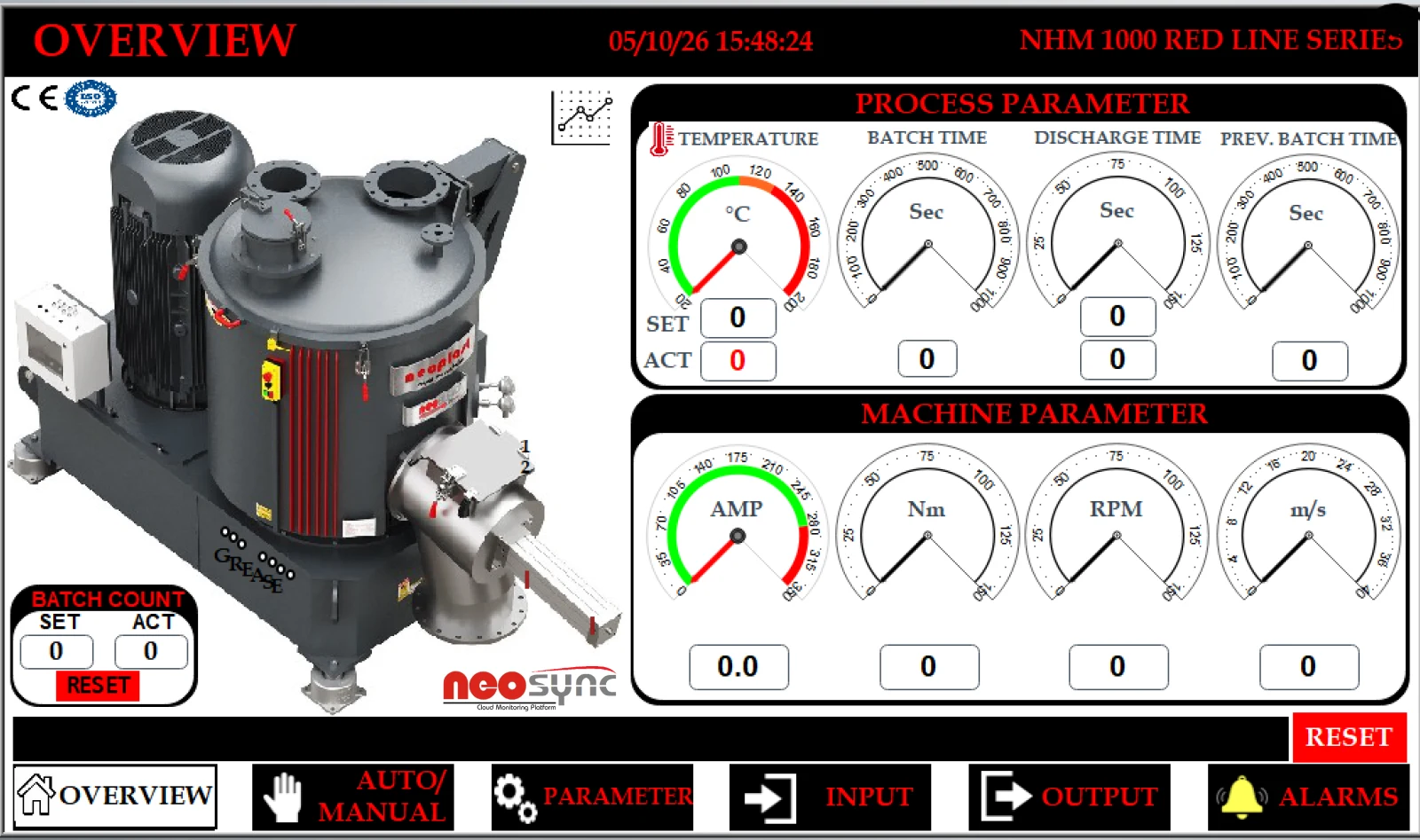
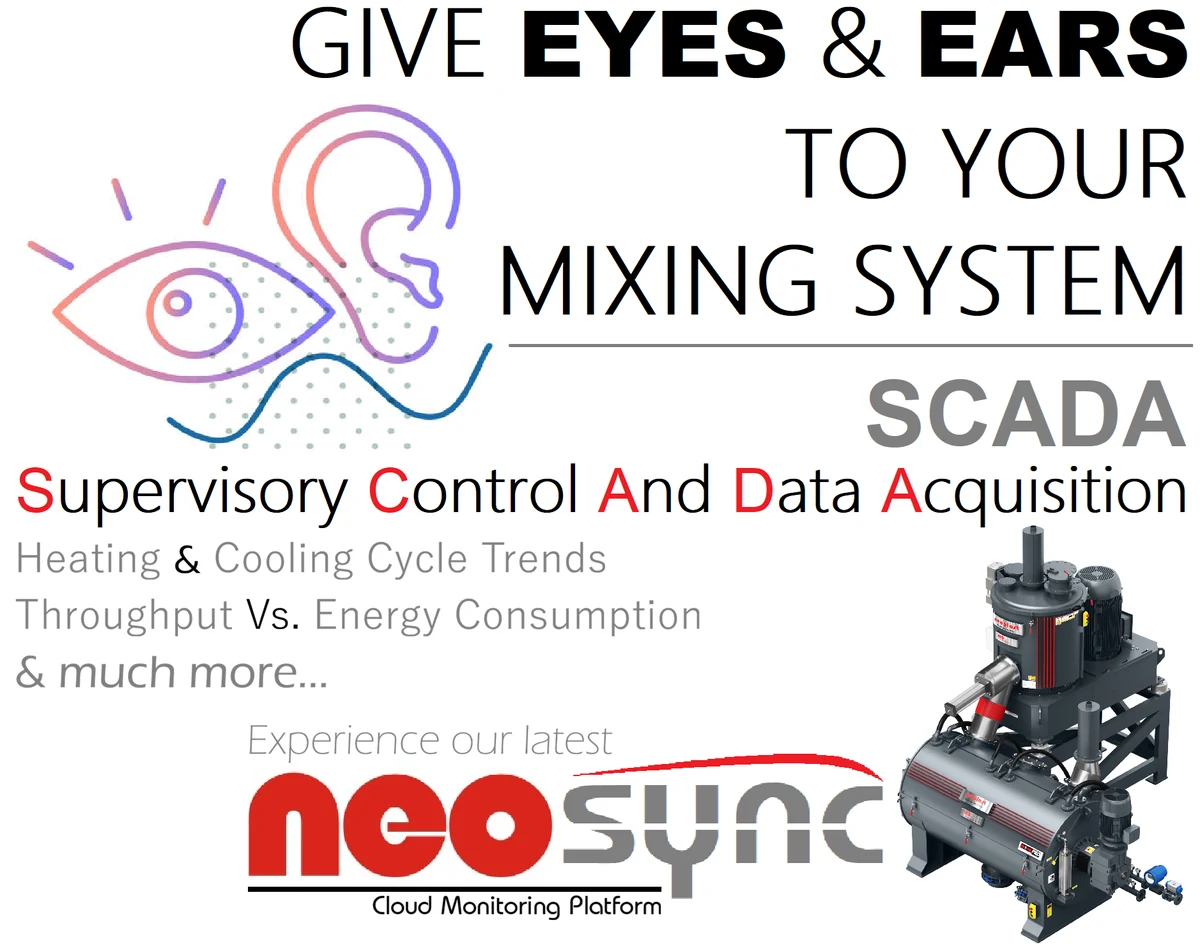
In mixing & conveying system, SCADA (Supervisory Control & Data Acquisition) system acts as the eyes & ears, providing real-time visualization, recipe management, & high-level control over the mixers & conveying which are actually the muscles of the system.
A local Programmable Logic Controller (PLC) handles millisecond-by-millisecond physical loops (like starting a motor or firing a pneumatic valve), the SCADA software translates that raw data into an interactive interface for plant operators.
® Platform Architecture: Sensor to ScreenThe flow of information travels up & down via 3 fundamental layers:
The Supervisory Layer (® SCADA Software)
Computers running SCADA suites (like WinCC, Ignition, or Wonderware) pull the data from the PLC over industrial networks (such as Modbus or Profinet), turning complex numbers into user-friendly graphics, alarm logs, & searchable reports.
The Control Layer (PLC)
PLC Hardware units read these raw electrical signals, convert them into data, and execute safety cut-offs instantly if a limit is breached.
The Field Layer (Sensors/Actuators)
Temperature probes read the heat, load cells calculate the weight, and pneumatic valves open doors.
® SCADA Platform brings to your entire systemFeature
What it Does
Provides an animated representation of the process, showing open/closed valves, spinning blades, & conveying course etc.
Production Value
Gives operators instant, full plant visibility at a glance.
Feature
What it Does
Triggers visual & audible warnings if the Heater Mixer exceeds 130°C, if the Cooler Mixer water circulation stops, if a motor draws too much amps, or if the silos/hoppers are empty etc.
Production Value
Prevents massive batches from burning, caking, or damaging the mixing tools.
Feature
What it Does
Log every temperature point, current draw, batch cycle time, & raw material weight permanently.
Production Value
Allows management to run audit trails, calculate shift yields, & trace quality issues back to a specific batch.
® SCADA Platform orchestrates the entire systemA standard compounding cycle utilizes a Heater Mixer to blend resin & additives via frictional heat up to 110–130°C, followed by a rapid-cooling Cooler Mixer that drops the temperature to 45–50°C to prevent lumping. SCADA orchestrates this entire process through a structured data workflow:
® SCADA interface.® displays the exact weight status of each raw material visually on the screen as they feed into the Heater Mixer.(At 32M/Sec. Tip speed, the PHYSICS shifts)
® continuously monitors & records live batch temperature from RTD sensors (Primary & Back-up) inside vessel of the heater mixer. The software plots a real-time thermal trend graph on the monitor. Operators watch the material temperature climb uniformly through its stages (e.g., ramping to 120°C within 5–8 minutes). Batch degradation protocol immediately activates if the temperature rises the set temperature limits or cycle time to avoid accident.® SCADA screen, the operator sees a visual animation of the discharge valve sequence & the material discharge into the Cooler Mixer.® tracks the cold mixing parameters, displaying the status of chilled water circulation pumps, water flow rates, and water return temperatures maintaining Δt. Anti-Condensation protocol immediately activates when the vessel jacket temperature reaches above wet-bulb temperature. When the compound cools safely to 45-50°C, SCADA visually captures the final discharge from the cooler mixer into storage hoppers or conveying to storage silos.® SCADA Platform 3-Tier Interlock Structure Safety interlock safeguards human life & prevent severe injury or death during mixing operation.
® advanced safety interlocks are designed to cut off power or isolate energy the moment a safety boundary is violated. They remain latched in a safe/tripped state & cannot be bypassed or restarted casually without a deliberate manual reset procedure & operator acknowledgment.
® Advance Safety Interlocks
Lid Safety Interlock
(Anti-Access during operation)
Coded Non-Contact Safety Switch
Prevents mixer motor from starting if vessel lid is open. If operator attempts to open lid while mixer is running, the circuit immediately breaks to kill power.
Discharge Valve Position Interlock
Contact Type Safety Switch with actuator
Prevents discharge valve to operate if discharge valve window is open. If operator attempts to open the inspection window of discharge valve while mixer is running, the circuit immediately breaks & stops discharge valve operation.
Solenoid Safety Interlock
(True Non-Return Safety)
(Fail-Safe Hold Function)
5/3 Valve with POV’s
5/3 valve combined with Pilot-Operated Check Valves (POVs) installed directly onto the cylinder ports. These physically lock the air inside the cylinder until the solenoid valve explicitly applies pilot pressure to release it, ensuring the lid never drops even if a hose burst.
E-Stop Chain
(Fail-Safe Device)
Mushroom Head Push Button
(Turn to release)
Hardwired emergency stop buttons is positioned on the mixer & main control panel. Pressing the E-Stop instantly cuts all power to mixer drive circuits via safety relays.
Mixing Tool Interlock
(Access only at ZERO RPM)
Solenoid Retention
High-speed blades possess immense kinetic energy & take time to come to a stop, a retention interlock utilize a time-delay solenoid lock. This prevents the operator from physically opening the lid until a pre-set time has passed or sensors detect the blades have ZERO RPM.
Note: Hundreds of interlocks (Primary/Secondary) makes the system complete. Above are only some of the crucial ones.
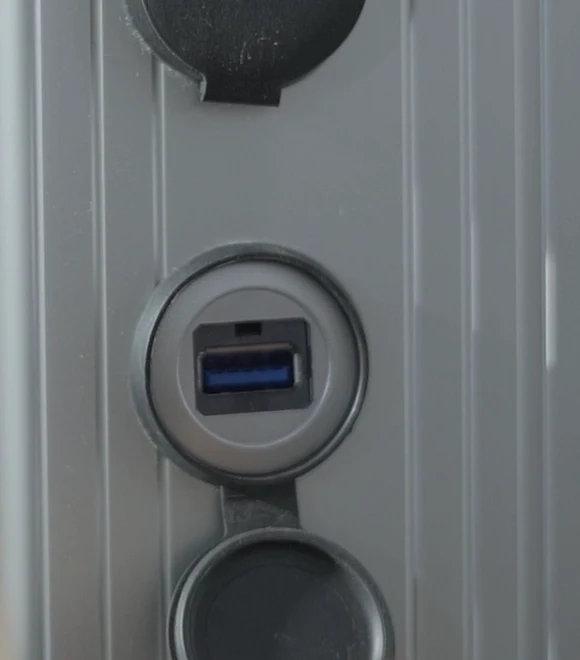
Mixer Data Transfer via USB
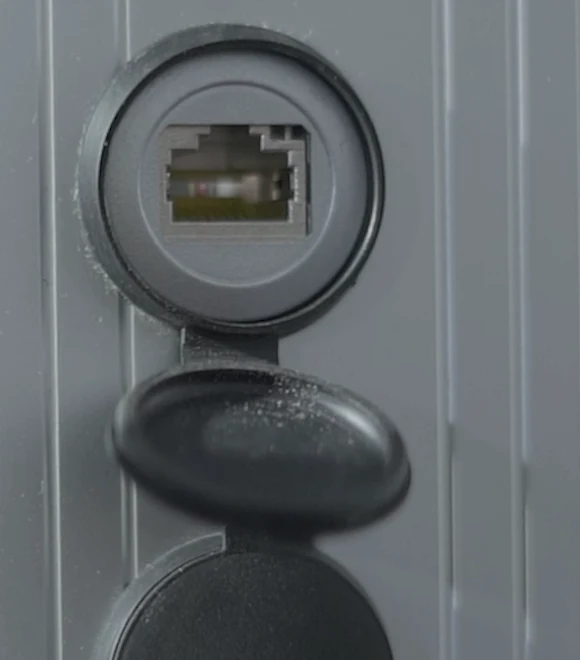
LAN Port
Industry 4.0 is redefining the industrial mixing landscape, the latest trends shaping adoption, & how forward-looking businesses are leveraging these innovations to gain a competitive edge.
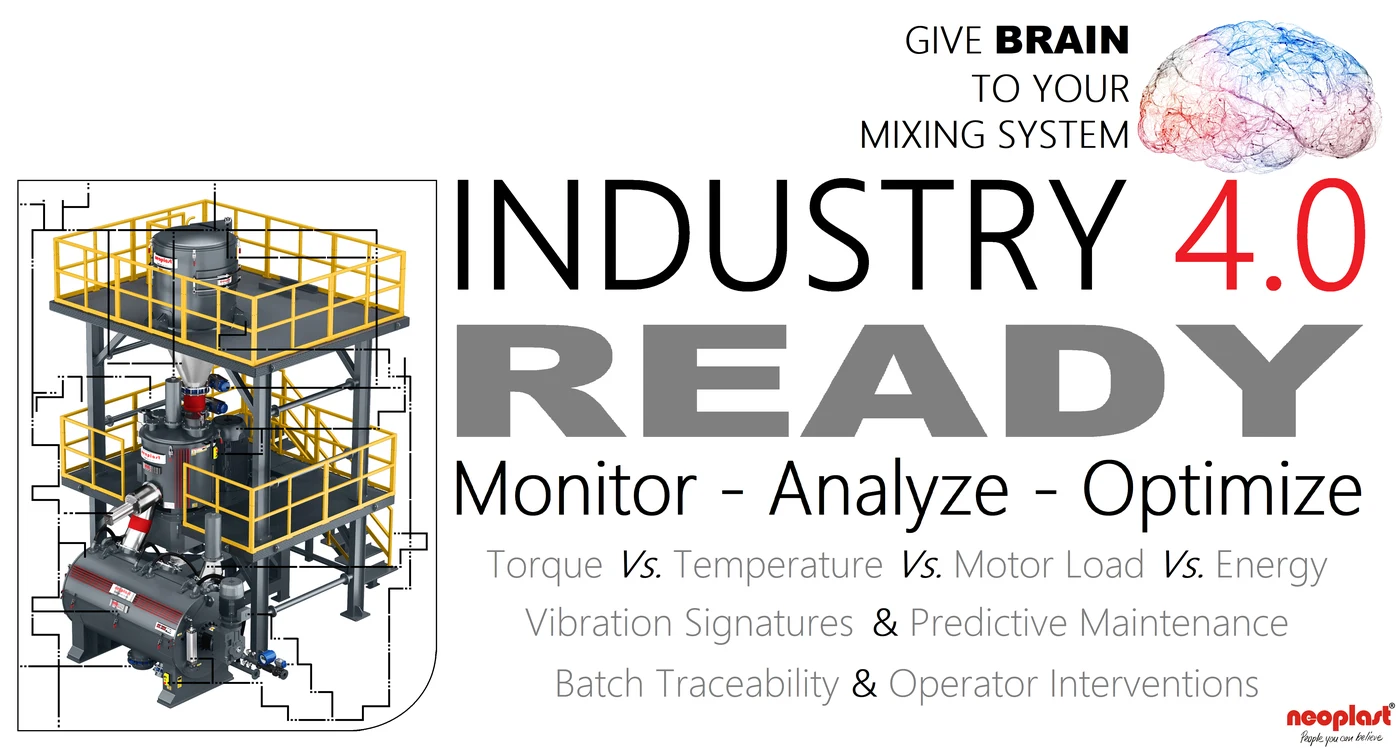
Implementing Industry 4.0 (smart manufacturing) on a mixing system involves connecting to a digital network for real-time data collection, automated recipe management, predictive maintenance, and quality traceability.
Industry 4.0 with ® (SCADA) involves convergence of field sensors, variable frequency drives (VFDs), & automated conveying & dosing units to a central PLC. This setup feeds real-time process data to a ® SCADA system for automated data analytics, machine learning, recipe control, batch traceability, & predictive maintenance in advance.
Examples:
Further, integrate the entire system with your ERP / MES.
Connect ® SCADA to your plant ERP or MES so production orders can automatically push recipes to the mixer & pull back raw material consumption data.
NEOBLEND® RED LINE Series
®Test & Development CentreTest your recipes together with ® directly on a suitable mixer.