
Home/Material Handling Systems/Weighing Station
Weighing Station - NW Series
CUSTOMREPEATED ACCURACYMODULAR
A powder additive weighing station measures exact amounts of fine ingredients before mixing them into a larger batch. When designing or setting up a powder additive weighing station, you must balance Material Flow & Powder Behaviour, Precise Weighing Accuracy & Load Cells, Containment & Dust Safety, Automation & Software Integration are some basic parameters to watch for. Repeated accuracy, recipe selection, real-time weighing, auger-controlled discharge, station logs etc. should be included to efficiently operate the one-pack weighing station. The system should be scalable & adaptable for future upgrades with SCADA protocol.
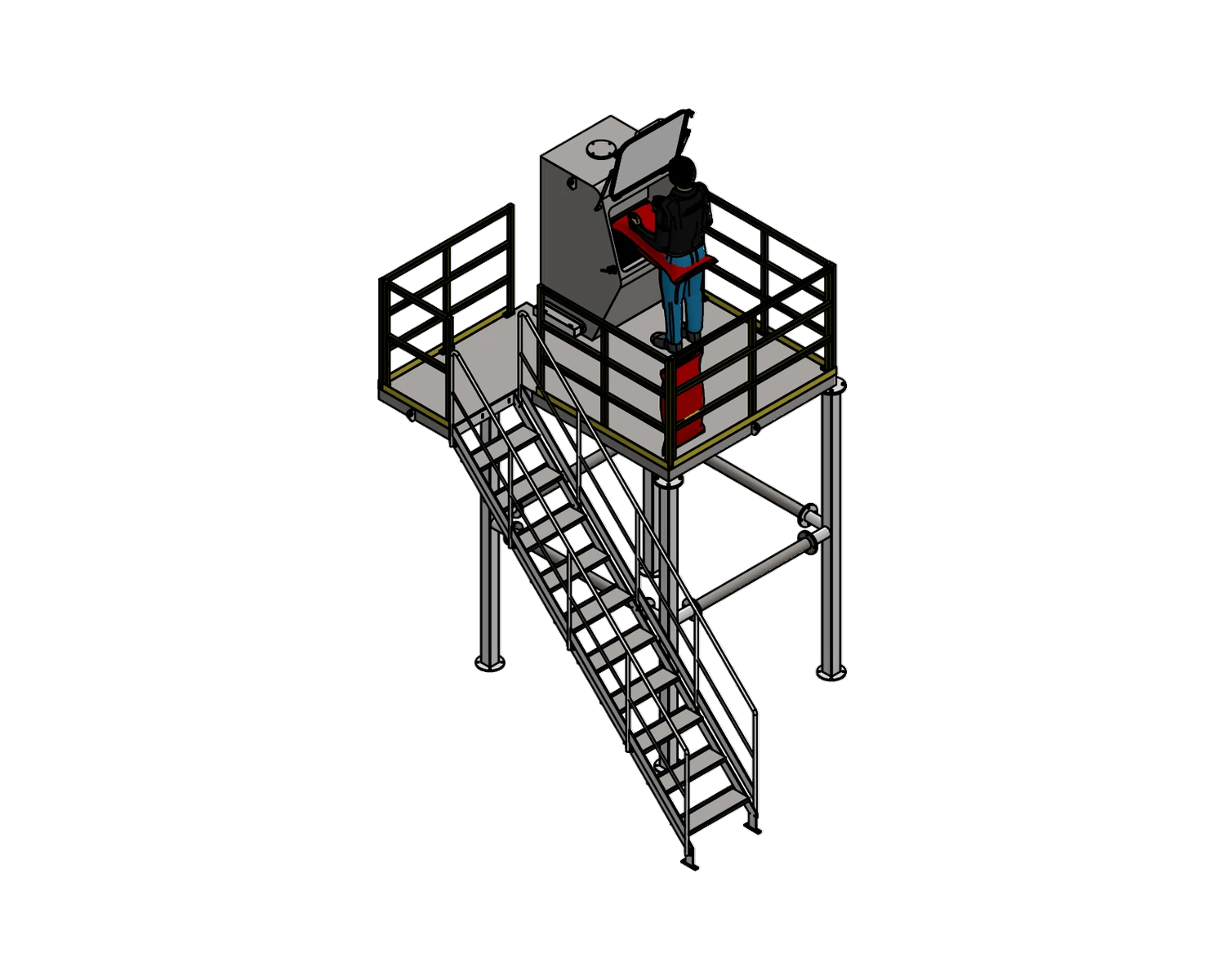
Additive Station manufactured keeping
People 1st - Accessibility through design
Advantages at a Glance
Value each gram – Beam type load cells & controlled helicoid auger with process automation hits exact target weights preventing costly overfeeds.
Repeated accuracy at full scale of ±0.2%.
Multi-Dosing configuration from 1 upto 6 units per system.
Quad Pitch Agitator to improve flowability.
Wide Opening with low deck feeding height.
Hood Open/Close via Gas Spring action.
Removable safety grill.
Operation via PLC with safety interlocks.
Bespoke Unit - Scalability & Adaptibility for future upgrades.
Ask the Expert
Always know your Bottom-Line requirements while choosing additive weighing station.
(Where you prepare your 1-Pack)
- 01
Remember, Minor Additive Stations are always customized & designed according to your 1-Pack recipe, powder characteristics & dosage. This is not “ONE SIZE FITS ALL” kind of a case.
- 02
Minor Additives like Impact Modifiers, Stabilizers, Wax, Processing Aid, Pigments etc. combined all together makes your 1-Pack which is aimed at enhancing specific properties of your final compound.
- 03
Minor additive dosage quantity is very less (Typically 0.1 To 2 PHR of the total 1-Pack). 1-Pack are typically 2 To 7 PHR of the total batch size.
- 04
To begin with, you select the variety of additives you need to convey into your batch recipe. This will help you decide the number of storage bins you need.
- 05
You select the weighing range of each additive you need to convey. This will help in selection of your 1-Pack system. Keep in mind the storage volume of the bins. Avoid frequent Top-ups. Once or twice Top-ups a day storage should be considered.
- 06
While selecting the system, opt for Agitation with Tapered Flight Auger configuration. Some additives are often hard to convey. Sticking, Lumping, Cracking, Climate Conditions etc. are some of the common factors affecting its flowability.
- 07
Look for Compact Footprints as operator would be generally filling the stations manually. The bins should be closer to each other with optimum feed height. Powder stations generally have a Circular of semi-circular orientation.
- 08
This application always requires micro level weighing. Repeated Weighing Accuracy should fall under ± 0.2% of your batch size.
- 09
Automation is the key. Real time system monitoring & adjustments reduces the risk of manual error & keeps the system Accurate. SCADA (Supervision Control & Data Acquisition) based system reduces operational costs by minimizing energy consumption & manual labor along with accurate weighing thorough fine & coarse feeding.
- 10
Scalability & customizations is must. 1-Pack System should have ability to adapt as per production needs. System should be expandable to keep up with the production demand. Future upgrades, minimal cost & downtime etc. can be achieved by installing bespoke units.
Technical data
Specifications
| Model | Bin Storage Cap.(Net Usable Vol.) * | Bin Dosing RangePer Minute | Storage Bins(Min. To Max.) | Weighing Hopper(Net Usable Vol.) |
|---|---|---|---|---|
| NW200 | 200 Ltr. (100 Kgs.) | Min. 1Kg. To 75Kg. Max. | 1 To 6 | 100 Ltr. (50Kg.) |
| NW500 | 500 Ltr. (250 Kgs.) | Custom | 1 To 6 | 200 Ltr. (100Kg) |
* Net usable volume considering Bulk Density of 0.55gm/cc
| Model | Screw Feeder | Agitator | Load Cell(Beam Type) | Level Sensors | Hammer Provision | Anti-Dusting Provision | Batch Abort |
|---|---|---|---|---|---|---|---|
| NW200 | YES | YES | 50 Kg. X 3 | Low | YES | YES | YES |
| NW500 | YES | YES | 100 Kg. X 3 | Low | YES | YES | YES |
| Model | Weighing Accuracy | Repeatability(Full Scale) | Level Sensors | Hammer Provision | Anti-Dusting Provision | Batch Abort |
|---|---|---|---|---|---|---|
| NW200 | ± 0.2% | ± 0.2% | Low | YES | YES | YES |
| NW500 | ± 0.2% | ± 0.2% | Low | YES | YES | YES |
| neo WEIGH Operation Scenario in Mixer Batch | |||
|---|---|---|---|
| One Pack Weighing Dosage | (Mixer Batch Size: 200Kg) | (Mixer Batch Size: 300Kg) | (Mixer Batch Size: 500Kg) |
| 5% To 10% of Mixer Batch Size | Min.10Kg. To Max. 20Kg. | Min. 15Kg. To Max. 30Kg. | Min. 25Kg. To Max. 50Kg. |
| 10% To 20% of Mixer Batch Size | Min. 20Kg. To Max. 40Kg. | Min. 30Kg. To Max. 60Kg. | Min. 50Kg. To Max. 100Kg. |
| 20% To 30% of Mixer Batch Size | Min. 40Kg. To Max. 60Kg | Min. 60Kg. To Max. 90Kg. | Min. 100Kg. To Max. 150Kg. |
Gallery
Turnkey Solutions
Material Handling Systems→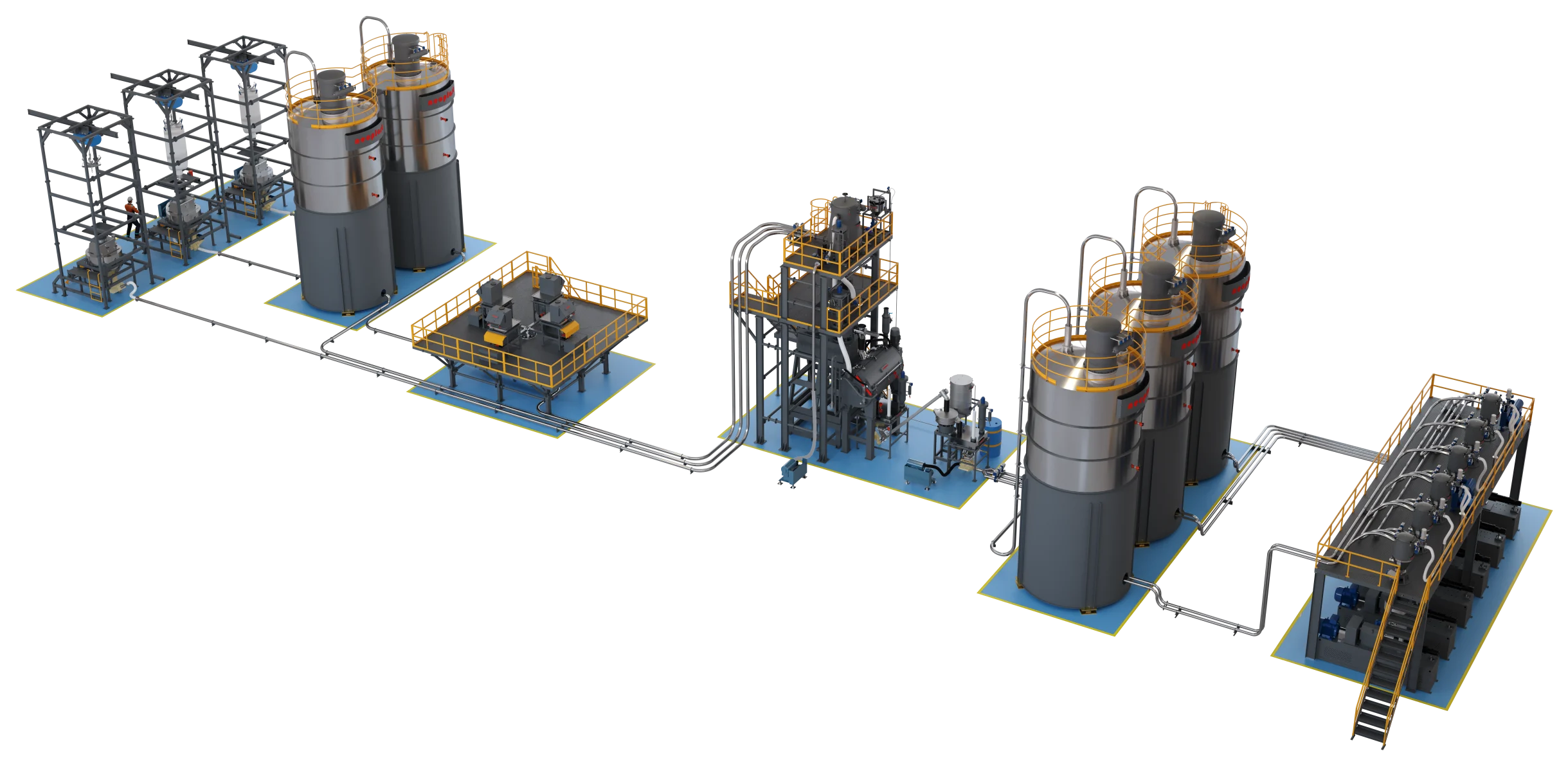
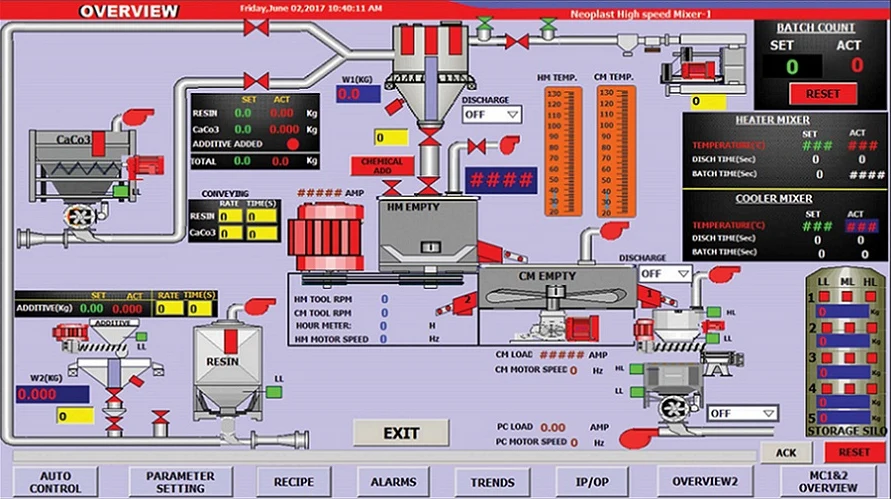
- Dust Free Environment
- Accuracy 0.1%
- Modular System
 ®Test & Development Centre
Test your recipes together with ® directly on a suitable mixer.